
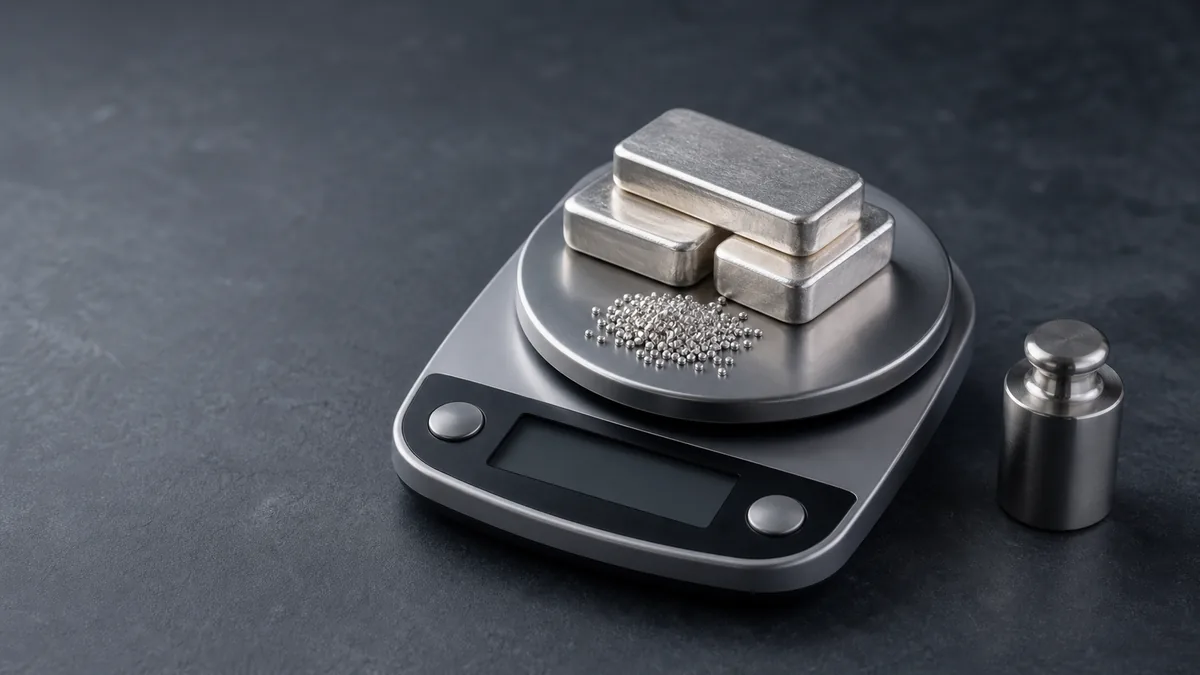
Silver price per ounce and gram: use the right ounce
Silver prices are usually quoted per troy ounce. Jewelry, flatware, scrap, and small bars may be weighed in grams. Converting between the two is simple, but only if the ounce in the quote is a troy ounce rather than the ordinary ounce used for groceries and packages.
NIST Handbook 44 lists one troy ounce as 31.1034768 grams. An avoirdupois ounce, the everyday U.S. unit, is 28.349523125 grams. Precious-metal markets use the troy figure.
The conversion is:
Silver price per gram = silver price per troy ounce / 31.1034768
The result is the reference value of one gram of pure silver. It does not include a dealer premium, refining charge, shipping cost, sales tax, collectible value, or the spread between buying and selling.
A hypothetical silver price example
Suppose silver is quoted at a hypothetical $31.10 per troy ounce. That is a round number chosen for the example, not a current silver price.
Dividing $31.10 by 31.1034768 gives almost exactly $1 per gram of pure silver. At that example price:
- 10 grams of pure silver has a reference metal value of about $10.
- 100 grams has a reference metal value of about $100.
- 250 grams has a reference metal value of about $250.
Real quotes will rarely produce such tidy answers. Keep a few decimal places while doing the calculation, then round the final estimate to cents.
The Gold & Silver Value Calculator works with troy-ounce weights. To use a weight stated in grams, divide the grams by 31.1034768 first. For example, 250 grams is about 8.0377 troy ounces.
Why 28.35 grams gives the wrong result
Using 28.35 grams per ounce makes the calculated price per gram about 9.7% too high. The arithmetic may look fine, but it answers the wrong question because it uses an avoirdupois ounce.
A label can add another wrinkle. In the bullion trade, a product described as a "one-ounce silver bar" normally refers to one troy ounce. A household scale that reports ordinary ounces may not be suitable for checking that weight. Grams are less ambiguous, provided the ounce price is converted with 31.1034768.
Purity comes after the unit conversion
The spot-price conversion assumes pure silver. Many silver objects are alloys, so their gross weight is not the same as their fine-silver content.
Sterling silver is commonly marked 925, which means the alloy is 92.5% silver by mass. Coin silver, jewelry, soldered hollowware, and mixed scrap may have different fineness. Use a reliable mark or test rather than guessing from color.
The purity adjustment is:
Estimated silver content value = weight in grams x pure-silver price per gram x fineness
At the hypothetical $31.10-per-troy-ounce price, 100 grams of sterling silver would contain about $92.49 worth of silver before refining costs and the buyer's margin. The remaining 7.5% of the alloy is not silver.
That does not mean a buyer will offer $92.49. A refiner may charge for testing, handling, and processing. A dealer also needs room between the purchase price and resale price. The calculation is a reference point for reading the offer, not an offer itself.
Gross weight can overstate silver content
A piece of flatware can contain knife blades, filled handles, solder, steel springs, or weighted bases. Jewelry may include stones, clasps, and other metals. A 100-gram object marked sterling does not always contain 92.5 grams of silver if part of its weight comes from non-silver components.
This is where online estimates become rough. A scale can measure the entire object, but it cannot separate a weighted base from the surrounding silver shell. For mixed items, a buyer may need to disassemble or assay the material before making a firm quote.
"Silver plate" is a different category. Plated objects have a thin silver layer over another metal and should not be valued by multiplying the full object weight by sterling fineness. Marks such as EPNS often refer to electroplated nickel silver, not solid sterling silver.
Spot, benchmark, bid, and retail price are different numbers
The LBMA precious-metal prices page describes the LBMA Silver Price as a benchmark set through an auction that starts at 12:00 London time. A live financial site may instead display a futures price, wholesale quote, midpoint, or delayed data feed.
Before converting a silver quote, check:
- the currency;
- the timestamp and any data delay;
- whether the unit is a troy ounce;
- whether the figure is a bid, ask, midpoint, benchmark, or futures price.
Two sites can show different figures without either calculation being broken. Their prices may represent different markets or moments. A dealer's retail price can be higher still because it includes the physical product and the cost of getting it to a customer.
For the market forces behind those moves, see why silver often moves more than gold and the Gold & Silver section.
Premiums matter more on small silver products
Physical silver is not normally sold at the raw reference price. A mint or refiner must fabricate the product, package it, move it through distribution, and verify it. Dealers add operating costs and a margin. Payment method, insurance, and shipping can change the final amount.
A $5 premium means something different on a one-ounce silver coin than on an ounce of gold because it is a much larger percentage of the silver item's metal value. Comparing only the advertised spot price misses that part of the transaction.
For a cleaner comparison, calculate:
Purchase premium per ounce = all-in purchase price per ounce - reference silver price per ounce
Then ask for the dealer's current buyback method. The gap between the all-in purchase price and the likely resale price is often more useful than the premium alone.
Scrap, bullion, and collectibles need different estimates
Bullion bars and widely traded bullion coins are usually discussed in relation to their silver content and market premium. Scrap silver is more likely to be discounted for assay and refining. Collectible coins may trade mainly on rarity, condition, and buyer demand rather than melt value.
Do not assume that an old coin is worth only its silver. Do not assume age makes it collectible, either. Metal value supplies a baseline; numismatic value requires a separate appraisal and a market for that specific item.
The same distinction applies to jewelry and decorative pieces. Workmanship or maker history may matter to a retail buyer even when a scrap dealer sees only recoverable silver.
Check the entire transaction
The CFTC's precious-metals fraud advisory warns about pitches involving guaranteed profits, undisclosed commissions, financed purchases, and questionable storage claims. A correct gram conversion cannot tell you whether a seller actually owns the metal being offered.
Before paying, get the product weight, fineness, total price, fees, delivery or storage terms, and buyback policy in writing. Check whether the quoted weight is gross weight or fine-silver weight. If storage is part of the deal, ask who holds the metal, where it is held, and whether the account identifies specific bars or only an unsecured claim.
Quick conversion checklist
- Confirm that the quoted ounce is a troy ounce.
- Divide the ounce price by 31.1034768 for the pure-silver price per gram.
- Multiply by tested fineness for sterling or another alloy.
- Exclude non-silver parts from the weight where possible.
- Treat premiums, spreads, taxes, shipping, and refining costs separately.
- Record the quote's source, currency, and time.
A silver price per gram is useful because it puts different products on the same unit basis. It is still only the metal calculation. The final price depends on what the object is, who is quoting it, and which costs sit between the reference market and the transaction.
Educational only. This article provides general information and hypothetical examples, not personalized financial, investment, tax, legal, or trading advice.
Sources
- NIST Handbook 44, Appendix C - U.S. unit-conversion tables, including troy ounces and grams.
- LBMA precious-metal prices - benchmark information for the LBMA Silver Price.
- CFTC: Precious Metals Fraud - warning signs involving commissions, financing, storage, and guaranteed-profit claims.